Saturday, February 3, 2018

Death Garage!


          In the next few entries, I’m presenting several ruins for your PA game or campaign.  My own setting is Pugmire meets Other Dust; change the setting details to suit your needs.
          I designed the ruin using the “What Is That Ruined Structure?” table in The Sandbox #1 with a flourish from Monte Cook’s Injecting the Weird. The tube-as-dungeon idea came from Runehammer’s video “Dungeon Building 101: Part 2”.
          The table uses all the standard dice to answer several questions.  Here are my results:
1.       Entrance: Wall or window has given way; Visible damage: outer sheathing is decaying and falling away; Original function: Entertainment (club or theater), What’s valuable inside: a functioning vehicle of some kind; What’s the threat: something waits for those who emerge; What’s unusual about this place: a vicious combat was here. Once a tower; now laying on its side(From Injecting the Weird). All checks are DC 15 (an idea from Runehammer.) The Runehammer channel also recommends each location has a Threat, a Timer, and a Treat, which I have included in this location.

The Death Garage

Surrounding Area

Steel splinters of a broken city loom around the ruin. A wooded sward trails behind it in a verdant wake.  Its entrance yawns like the broken-toothed maw of an idiot god, an amphitheater of destruction choked with rubble. The implacable agents of decay-rust, vines, lichen-penetrate every crack and fissure.
A one-mile halo of mayhem encompasses the ruin. The fragments of war machines and fused automatons testify of a long-forgotten battle. There is little to salvage.

Getting In

The way to the entrance is difficult and close; only one character at a time can make their way into the ruin. Characters must make few Strength or Dex saves to see if anyone takes 1 hp of scrapes and bruises. Once inside, they are in near-total darkness, standing on the edge of a fifty-foot drop.  This is the parking level of an entertainment complex. The complex, a high tower filled with clubs and restaurants, toppled over in the battle. The parabolic entrance is the tower’s bottom edge, ripped from its foundation. In the intervening years, time has buried the bulk of the tower and plants have taken hold on the land above it.  This is the green sward that cuts through the rubble of the city. This bastion of nature presents its own set of adventuring opportunities.
Standing inside the ruin, the PC’s can see a few blinking lights at different levels below them in the darkness. These are running lights of the few grav cars whose batteries are still good.  Some of them float in pairs forming platforms. Others hang from one corner as if pinched by a giant's fingers. They pirouette like demented party lights.  The "floor" is a thick layer of wrecked and rusting vehicles that slid to the ceiling when the garage toppled. The treat hovers above the wreckage: a pristine black grav car, its stereo thumping.

Descending the Tower

Once all the PC's have all reached the first floating car, roll a d4. Describe a terrible grinding sound. An ancient robot from the battlefield had powered up and is trying to chase them into the garage!  In up to four rounds it will tear an opening in the ruin large enough to get itself in (and to get the grav car out). It will then enter the ruin and attack the characters, trying to destroy them as they leap from car to car.
If the players leave a guard at the entrance, the robot ignores the guard. It focuses on getting into the tower to attack the group. If you must, give the robot a dying shield that lasts as long as the timer.
Characters make 3-5 checks to get to the lower level and reach the Treat.  The floating cars are between eight and fifteen feet apart, but most of this distance is vertical.  Failing the check for moving from car to car results in a character hanging from the target car for dear life. Critical failure means the car’s battery dies it plunges to the floor!  Anyone of a falling car takes 2d6 damage as the vehicle drops. Crashing into other grav cars on the way down slows the vehicle's fall.  This can send cars spinning off in other directions, re-configuring the battlefield!

The Robot

The robot can be expressed in several ways, depending on the group’s level and makeup.  It leaps and climbs like a gorilla, charging the PC’s to knock them off the cars.  Add a climb speed and construct qualities to the following creatures and ignore irrelevant abilities:

Minotaur Skeleton (CR 2)
Minotaur (CR 3)
Gorgon(CR 5)
Clay golem (CR 9)
Girrilon (Volo’s Guide to Monsters) (CR 4)
Ogre, add the pounce ability from a tiger (CR 3)
Iron golem (CR 16)

Other Monsters

On every round that someone stands on the wreckage at the bottom of the garage, 1d4 rust monsters appear. They live in the strata of rusty cars and are hungry for fresh metal.  If the PC’s are clever, they can kite the robot onto the floor and let the rust monsters swarm it. The rust monsters ignore the black car because they hate the taste of its nano-enhanced body. (or because of the vibrations of the stereo.  If the players turn it off, the rust monsters swarm the car!)
Besides to the rust monsters, there are three darkmantles living on the ceiling of the ruin.  They drop on prey and use darkness to make leaping or climbing between grav cars much more hazardous.

The Car and the AI

Hooks to retrieve the treat car could include an assignment, a map, or a happy accident. It may have led the PC's to itself via a key card with GPS.  Emphasize that the car looks badass: black, aerodynamic, expensive.  Make it drool-worthy. Emphasize that the hole the robot tore in the entrance is big enough for the car. The car may contain a personal possession of the former owner or a key card to an executive suite higher/deeper in the tower. In a post-recording world, the sound system is a priceless treasure.
Nigel, the car's friendly AI, is unclear about what’s happened in the last several centuries. It can tell PC's a little about life before the fall, but it has no news of the years it spent hovering in the dark. Nigel is politely curious about who is driving the car and why they smell like dog. The GM can decide how keyed into the internet of things Nigel is, and whether it can access the net at any given time. Nigel can maneuver the car out of the garage if asked. The PC’s can make Nigel an ally if they treat it with a modicum of respect.  It will do its job regardless of treatment, but no more if the PC’s abuse it.
The car can’t fly, but it can levitate up to one hundred feet with limited mobility and speed.  Consider its Speed score to be 0 when levitating, with a fly speed of 20 feet. (Speed is a Sine Nomine quality of vehicles seen in Stars Without Number and Other Dust.)

The Rest of the Tower

The rest of the buried tower awaits exploration.  It is an entertainment complex full of holo-suites, dance clubs, bars, restaurants and private rooms. Populate it with vermin, mutants, and fungal threats, as well as demented companion, service, and security bots.
       
The Death Garage!


The garage and the rest of the tower.  The small maps are extras.

          Any questions or comments that could improve this encounter and location are welcome.  I'm always trying to improve as a GM and designer, and I sure as shootin' don't have all the answers.

Saturday, January 20, 2018

Monster AI, Challenge Adjustments and Learning to Love the Monster Manual

Runehammer is one of my favorite You Tube channels.  Hankrin Feranale (hankerin’ fer an ale. Get it?) presents D&D as an old-school-meets-board-games tactical story-telling experience, and it works for me.  Ken Hite once said the whole point of narrative in D&D is to string the fights together, and Hankrin seems to subscribe to that philosophy.
That said, he knows how to squeeze a lot of narrative juice out of combat encounters.  His videos on monster AI and adjusting challenges are must-watch for any GM who wants to get more out of combat than a hit-point countdown.  (Note that Runehammer started out as Drunkens and Dragons, and Hank gets hammered in quite a few of his vids, but the core content is worth the obnoxious You-Tubery.)
I applied the wisdom in these videos to my Dr. Levinson the-Fly-Meets-Immortan-Joe cul-de-sac encounter, and here’s what I came up with:
AI for Dr. Levinson:
Hankrin suggests pre-determining monster behavior via logic gates and writing the routines on index cards.  Here are my three cards, for preparation (his passive state, in which he prepares his evil master plan for world insectoid domination), aggressive and retreating behavior.

LOS is line of sight, which means he tries to get out of sight for ranged attacks, or find a LOS for ranged attacks.  Place of Safety means he’s in his lair, rather than out and about getting ready for world domination.  Timer means he sets off the timer (see below) that sends a wave of buggy death into the surrounding area.


Damage: Since I’m going to be using Pugmire which is based on the  5e SRD, I decided to look at the 5th Monster Manual to check out the Ankheg, a bug-monster that DR. Levinson was going to summon on a natural 20.  I found that the Ankheg was essentially what I wanted Dr. Levinson to be, so now he’s mechanically a super-intelligent Ankheg with Spider Climb and the ability to summon Stirges on any even roll above 16.
I decided to double the damage for Dr. Levinson, because I want him to be deadly and scary, as well as a potential recurring villain.  I’m using fixed monster damage, an option listed in the 5e MM, so we’ll see how that goes.
There are enough new factors in this encounter that I didn’t also want to add the complexity of monsters from multiple sources. I took out most of the 13th Age and Other Dust mechanics for Levinson and added an animated carpet to the encounter.  The “carpet” is really a swarm of insects controlled by Levinson that overwhelms a character and tries to force its way into their body.  Gross and scary, I hope.
Disruption: Disruption dictates how much freedom to act the PC’s have in the encounter.  Hank’s illustration of a low disruption encounter is fighting a balrog in an empty parking lot.  A high-disruption encounter might have broken terrain, traps, changes in elevation, and so on.  The disruption effects in Levinson’s lair are all DC 12 (another of Hank’s ideas: one disruption DC per encounter), and they all have the same effect: they disrupt the characters’ ability to act freely. The lair is full of termite-damaged floors and walls, line-of-sight disruptions in the form of debris and termite mounds, and an ongoing effect called “swarm skeeve” (name suggestions welcome, btw) that’s a DC 12 Charisma save.  Characters who fail the save must spend a round swatting, stomping and generally being occupied with the layer of insects that undulate all over and fly through the encounter.  Certain areas of the floor are badly damaged; avoiding them requires a Wisdom or Dex save. Characters who fail must spend a round extracting a foot or other appendage from the broken floor. Between the skeevy swarm, the weakened structure, and the termite mounds blocking line of sight, this should be a fairly disruptive encounter.
Duration: If Dr. Levinson successfully retreats, the PC’s have 1d4 rounds to prepare before he unleashes a wave of heritor bugs, which will overwhelm the PC’s and disperse into the world in a twenty mile radius from the cul de sac.  All settlements within that radius will have their resources reduced by one level.  All level one settlements will be destroyed. (Rules for enclave rankings and resources can be found in Other Dust.)
So there you have it!  AI and challenge tuning for Pugmire and other PA games!  I hope you enjoy the ideas from Runehammer.  Give him a look, a like, and subscribe if you dig his stuff!

(Here are links to Hank’s video on timers and one of his brilliant room design vids.  I used these ideas in the encounter design, but I didn’t write them in to keep it reasonably brief.)

Saturday, January 6, 2018

It all comes together in Pugmire. (Seriously.)

Pugmire is where it all comes together. Less Fury Road and More Gamma World, Pugmire is a game set in a post-human future where uplifted dogs, cats, lizards and rats live in rough equivalent of a D&D-style medieval society. The first thing that comes to a lot of minds when they hear of this setting are either furry jokes or jokes about dogs’ less noble behaviors like humping legs and sniffing butts. Go ahead and have your giggle, but then get ready for some deep role playing.

The sense of loss in Pugmire is profound. Dogs all have some response to the Code of Man, a set of edicts meant to provide moral structure for dog society. Some dogs respond to the call of Man with serious devotion, even dedicating their lives to Man’s service: doing good works in Man’s name, seeking artifacts of His reign, and generally trying to shepherd others towards the ideal of being “Good dogs.” Others are skeptical pragmatists, wondering if Man was ever really worth obeying or if He was in fact just another animal: nor more or less noble than the dogs themselves. Still others revel in their freedom and run (and run and run and run) with it. Each dog’s attitude towards Man provides a large part of her role-playing impetus. The Pugmire book suggests that man has perhaps evolved and shed his mortal shell to ascend to a higher plane.

Enter Other Dust. In this setting, the Earth has been abandoned by star-faring humans because it has become an inaccessible death trap. The setting details why, but the parties responsible for isolating Earth so totally are a cadre of seven human super-psychics called The Crazed. These men and women are the lich-kings of the setting: horrifically powerful, immortal, and completely insane. If Arkham Asylum were a prison for mad gods, the Crazed would be right at home there. Add this bit of back story to the world of Pugmire, don’t tell your players, and suddenly you’ve got a role-playing time bomb worthy of John Wick. What will your devoted shepherd do when she discovers that the wasted earth she and her puppies have inherited came to her compliments of the best Man had to offer?  Will your cynical ratter still aspire to be a Good Dog when he has had to journey through a forest of formerly-human cancer trees, the handiwork of one of the Crazed?  If Mankind was so simultaneously fragile and cruel, what is the use of following the code? What will the dogs do when their gods are dead?

Pugmire bills itself as lighthearted and family friendly, but with the backstory of Other Dust, darker themes become an option.

Beyond its potential for thematic depth and role-playing drama (meaning stories in which characters must change in some way as they progress), Pugmire is very versatile mechanically. Based on the D&D 5th edition SRD, Pugmire invites monsters and locations from pretty much all editions of D&D and other d20 material (d20 Gamma World gathering dust? How about d20 Call of C’thulhu? Bust them out and populate some ruins). While written for Savage Worlds, Andy Hopp’s Low Life is a great source of weird cults, locations and misinterpretations of the age of Man.  Even The Day after Ragnarok can provide cool adventure hooks and campaign frameworks for a game of Pugmire.  The Mutant: Year Zero free starter booklet provides some cool ideas and locations that would sing in a Pugmire campaign. And I would be remiss if I left out Numenera, a game which while fun in its own right, is full of ideas applicable to Pugmire.

Of all o these options, Other Dust provides the most Pugmire bang for your buck. OD has tools for generating gear, artifacts, locations, and adventures that are just what the Shepherd ordered for Pugmire. While capable of great thematic depth, Pugmire also shines as a game about exploring ruins and fighting monster, which Other Dust robustly supports with many maps and tables. The free material for Other Dust, including the excellent adventure Grandfather’s Rain, is bursting with adventure hooks, creatures and gear to challenge and entice Pugmire players. The free zine,The Sandbox, also has a great ruin generator. Finally, Hard Light, an adventure for Stars Without Number, has a tool set for generating tombs that would allow a sci-fi spin on a Barrowmaze-style campaign.


Pugmire won’t give you Mutant Crawl Classics-style gonzo craziness (though the patron AI's could make an appearance) or grim survival rules (though you could import them) or cool car battles (ditto), but it will provide a unique post-apocalyptic take on the terrible consequences of getting what you want.  It  will also give you full use out of your 5e books and it invites use of other material of multiple genres. I highly recommend Pugmire, and I am looking forward to seeing what my game group does with it.

Sunday, October 22, 2017

Using Silent Legions and 13th Age mechanics to make an OSR post apocalyptic monster boss

In the last entry, I used Kevin Crawford’s Other Dust to flesh out a ruined cul de sac complete with a insectoid mutated military scientist bent on unleashing a massive colony of radioactive bugs onto an unsuspecting wasteland.  The mad scientist, who I’ve decided to call Dr. Levinson, needs some stats.  I’ll be using ideas from Silent Legions and 13th Age to create the good doctor.
Silent Legions builds on the monster/mutant/alien toolboxes in Stars Without Number and Other Dust by presenting a menu of base creatures and adding a few add-ons to make the creatures unique.  I chose the Humanoid Thing, Average as the base for Dr. Levinson.  (Silent legion presents creatures as a generic type like Hulking Brute and Verminous Beast and gives three variants of each--weak, average and strong—with appropriate stats for each.) Average Humanoid Things have the following stats:

AC: 8. HD:2. Attacks: bite+wpn. +Hit:+2. Damage: 1d6+wpn. Speed: 30'. Morale:8. Skill:2

I’ll give him the Acidic template, which modifies his stats by upping damage and +Hit, but lowers morale.  Additionally, Dr. Levinson will be in body armor and carrying a laser pistol. 13th Age has some compelling reasons for giving monsters static damage rather than dice, so his final stat block is this:

AC: 4 (14 if using ascending AC). HD: 2. Attacks: Caustic claw and laser pistol. +Hit: +3. Damage: Caustic claw 3 +1 acid, 1 acid for 1d4 rounds/ laser pistol 3. Speed: 30', wall crawler (can move on any surface like walking). Morale: 6. Science: 2.

One of the things I love about the Sine Nomine sandbox tools is how they allow the GM to discover the game setting right along with the players.  Monsters with lots of GM activated powers turn the play experience into a tactical battle, while monsters with only claw/claw/bite can be tiresome.
13th Age monster design has monster abilities activating based on the to-hit roll or the number on the escalation die (a die that counts rounds and has other mechanical effects in that game.)  Applying that principle to OSR monsters allows the gm to watch and enjoy the experience of the combat without switching roles from tour guide to tactical opponent.  (Of course, if you want to match wits with your players as a combatant, feel free.  However, I would rather facilitate their experience than be responsible for remembering how many times a breath weapon has been used or whether the spell-likes have been activated.)  I want Dr. Levinson to have some acid-puke ability as well as a swarm summoning that comes after a certain number of rounds.  I will also throw in a random mook bug showing up with certain die results. To add this kind of AI to the monster, I’ll tie certain effects to d20 rolls.

Even Hit 16+: Acid vomit.  Does 5 damage and 2 ongoing acid damage for 2 rounds.  Fortitude save for half and negates ongoing damage.
Even Miss: One heritor bug appears to fight with Dr. Levinson. (Heritor bugs are giant roaches; any low-level vermin will do.)
Natural 20: An Ankheg appears to fight with Dr. Levinson

Should he fail a morale save, Dr. Levinson will retreat easily by scooting up the wall and out a window or into a hole in the floor. His insect minions will not follow him, but will continue to fight the PC’s to block any attempts at pursuit. Dr. Levinson will disappear and become impossible to catch if he is not caught in three rounds.

Now I have a boss monster for my cul de sac, a summoner with a ranged and a melee attack who will run away to fight another day.  Dr. Levinson could be a short fight or a recurring villain, always seeking to cleanse the earth of the plague of primates that prevent the ascendency of the insect horde. The final form of Dr. Levinson is this:

AC: 4 (14 if using ascending AC). HD:2. Attacks: Caustic claw +laser pistol. +Hit:+3. Damage: Caustic claw 3 +1 acid, 1 acid for 1d4 rounds/ laser pistol 3. Speed: 30’, wall crawler (can move on any surface like walking). Morale:6. Science:2.
Even Hit 16+: Acid vomit.  Does 5 damage and 2 ongoing acid damage for 2 rounds.  Fortitude save negates ongoing damage.
Even Miss: One heritor bug appears to fight with Dr. Levinson. (Heritor bugs are giant roaches; any low-level vermin will do.)
Natural 20: An Ankheg appears to fight with Dr. Levinson

Sunday, July 30, 2017

Making a Cul de sac Ruin With Google Earth and Other Dust

I've been enjoying the RPG mapping community lately.  There are a lot of helpful, generous, creative people making all kinds of fun, free maps for RPG's that I got a little excited and decided to try my hand at mapping, something I haven't done for years.

To create the ruin I wanted to map, I used the ruin generator from Other Dust.  This is about as good a generator as you can find, and it gives just enough detail to spur the mind to new and interesting avenues.  I rolled on the Ruin Origins table and got Suburban Wreckage.  I thought immediately of Sanctuary Hills in Fallout 4, the first settlement the vault dweller encounters in the game.  Sanctuary Hills is a ruined cul de sac, full of interesting back story and useful items and work stations.

I then rolled on the Ruin Destruction table and got Decay.  Ruin destruction tells what put the ruin in its current state. Basically, the place was quickly abandoned and then went to seed.  So I've got an abandoned cul de sac with buildings that are in various states of dilapidation.  Hm.

Next came the Ruin Inhabitants table, on which I rolled Beasts. The first thing that came to mind was an insect infestation: heritor bugs (the Other Dust version of PostApoc cockroaches), maybe an ankheg or rhemoraz (because D&D monsters are great for Post Apoc monsters as well in OSR games).  Things are coming together.  I have an abandoned residential area in a state of deep decay populated by monstrous bugs.  Nice.

Last came the Ruin Tags. Tags are one of Kevin Crawford's genius inventions, and basically are an evocative word or phrase combined with a number of variables like Friend, Enemy, Secret and Complication.  The tags I rolled up were Mad Scientist and Doomsday Countdown.  Things are about to get funky in the cul de sac.

I decided that the Mad Scientist is a recently thawed-out military officer who has been mutated into an insectile creature with the ability to control and summon bugs. Think Immortan Joe meets The Fly.  His mutation has driven him mad and he wants to overrun the world with insects.  He has to finish brewing a pheromone bomb which he intends to detonate under the cul de sac, sending the massive colony of bugs that live there into a killing frenzy, cleansing the world once and for all of the evil influence of man. The Mad Science tag led me to decide that he has been experimenting with human subjects, in order to make the pheromones trigger only a certain type of murderous behavior on the part of the insects.

The story elements were in place.  Now I needed stats for the Mad Scientist (that's next week's post) and a map.

I googled Post Apoc RPG maps, and found a few neat things (random ruins,random wasteland) but nothing really fit the bill for a pre-fab housing developmet. Then, it hit me: Google Earth was loaded with top down views of all kinds of places from residential areas to industrial and military complexes.  I started looking around my location and sure enough I found a cul de sac with several large homes perfect for the lair of the mad military scientist and his insect horde.

I took a marker, graph paper, and copied the layout.  Then I added details, including some random elements for exploration because you should be able to use and reuse a cul de sac map; they're all over the place and they're all similar. Here it is:

Not quite Sanctuary Hills


It's not the prettiest, but it's done and I can re-use it.  Random rolls can tell me which buildings are explorable and I can populate them with critters and loot via the Other Dust random tables as well.

How do you find make or find maps for your post-apoc games? Leave a comment below!


Thursday, June 22, 2017

Art post!


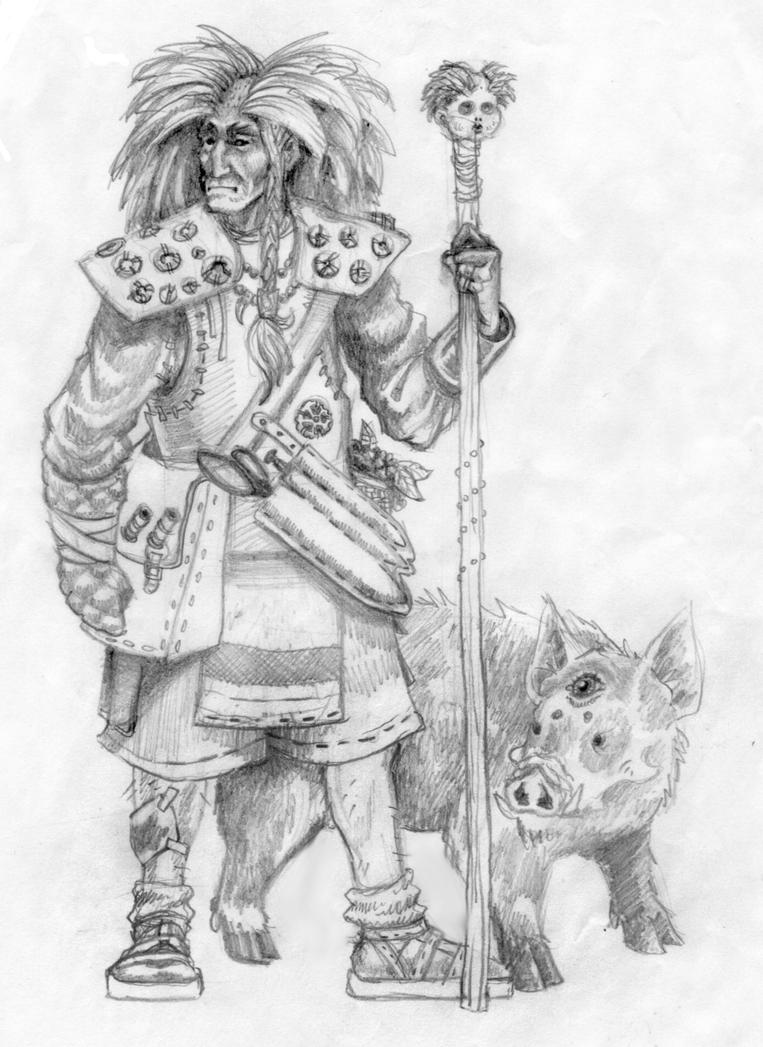
This is an illustration I did for a Savage Worlds post-apoc idea a while back.  The character is named Charlie Crow, and he's a Nuid, a protector of life in Nu Earth. His companion is a four-eyed pig with a high Smarts and the Alertness feat.  Charlie could fit into any Post Apoc campaign, including the new Mutant Crawl Classics game by Goodman Games.  Here's a link to a larger image of Charlie and the rest of my Deviant Art gallery:

Saturday, January 21, 2017

An embarrassment of riches from a single video

I saw a video recently of a group of bicyclists trying to extract one of their bikes from an electric fence.  (I had linked to the video, which was hilarious, but it is no longer available.)  There were many attempts to grab the metal bike which zapped the hapless bikers over and over, lots and lots of profanity, and eventual victory. There were quite a few amused passers by.

My mind sparked off this, because it's such a ridiculous and simultaneously slightly dangerous situation.  Here are five ideas for PA gaming based on this amazing video:

1. A gear trap, that ensnares a valuable or essential bit of loot already in the PC's possesion, could be a fun or annoying challenge.  The passersby, were they approaching hostiles, would ramp up the situation and turn it from comic to tense.

2. The "damage" from the fence is light, but intimidating.  Single hit points wouldn't bother a hard character but minor conditions, or a -1 to all rolls per jolt, wearing off in time, could be interesting.

3. The "cool gear in a difficult to reach place" doesn't have to be a dungeon.  It could be half a motorcycle sticking out of a rubble pile or the aftermath of a landslide...or wrapped up in a an electric fence. This type of thing could be a random encounter.

4. The damage/challenge could be ambient: radiation, a la Fallout, with treasure on top of a mound of radioactive waste barrels, or in the midst of a lair of a swarming pest or insects, could provide a fun and recurring challenge. (You got the motorcycle out, but it's still radioactive or infested with radioactive ants.)

5. There could already be a group trying to extract the gear or treasure from the obstacle, providing an opportunity to role-play, parlay, or have a fight over something that could be damaged in the dust-up, preferably with a huge explosion (again, a la Fallout.)